War Room to LAN Room: 5 Military Doctrines Elite Esports Teams Are Running Right Now
There's a moment in every high-stakes esports match where the chaos peaks — rotations break down, the enemy pulls something unexpected, and five people on a headset have about two seconds to recalibrate before the round is gone. That's not just a gaming problem. That's a warfighting problem. And it turns out, the people who've spent decades solving warfighting problems have already written the playbook.
Elite esports organizations — the ones consistently making deep tournament runs, the ones with full-time coaching staffs and sports psychologists on retainer — have been quietly borrowing from US military doctrine for years. Not as a gimmick. Not as branding. As a functional competitive framework. At Sons of Kryos, we believe competitive gaming is a legitimate theater of strategy and discipline, and this piece is proof of that claim.
Here are five real military doctrines that pro esports teams have adopted, adapted, and weaponized.
1. The OODA Loop: Observe, Orient, Decide, Act
Developed by US Air Force Colonel John Boyd after studying aerial combat in the Korean War, the OODA Loop is the foundational model for decision-making under pressure. The concept is simple: the fighter who can cycle through Observe → Orient → Decide → Act faster than their opponent gains a decisive advantage — not just once, but repeatedly, until the enemy's decision-making collapses entirely.
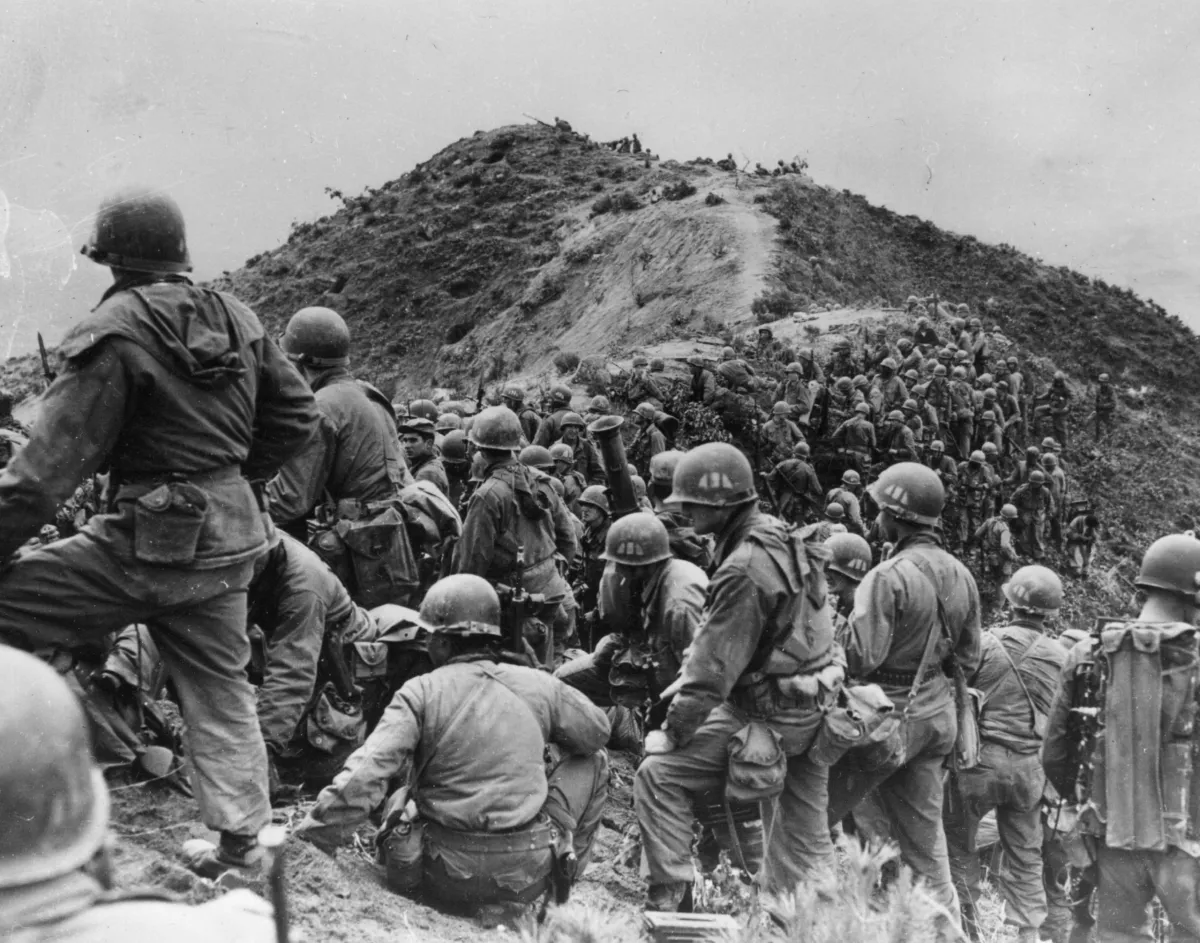 Photo: Korean War, via fox59.com
 Photo: John Boyd, via blogger.googleusercontent.com
In esports, this maps almost perfectly onto the concept of "tempo" — the ability to force reactions rather than react yourself. Cloud9's coaching staff has publicly discussed cognitive cycling speed as a training priority, particularly in their CS:GO programs. The goal isn't just to make good decisions; it's to make them faster than the other team can process what's happening.
Where teams apply this most visibly is in information warfare. Smoke placements, fake executes, and deliberate sound cues are all designed to force the opponent into the Observe and Orient phases repeatedly, buying your team time to Act while they're still deciding. That's Boyd's loop, running in a virtual server.
2. Fire Team Communication Structure
The US military doesn't let a squad operate as a flat, leaderless group. Even a four-person fire team has a designated leader, a specific communication hierarchy, and pre-established call-outs that eliminate ambiguity under fire. Every message is short, direct, and actionable.
Look at how top-tier Valorant and CS2 rosters communicate mid-round and you're watching the same philosophy at work. Teams like Team Liquid have been documented running structured communication audits — reviewing VODs specifically for call clarity, redundant information, and "comms pollution" (talking that doesn't drive decisions). Their coaching staff doesn't just analyze plays; they analyze how information moved between players.
The military principle here is that unclear communication in a firefight costs lives. In a pistol round, it costs the economy. Same stakes, different consequences — but the solution is identical: standardize the language, assign clear roles, and trust the structure.
3. Decentralized Command (Mission Command Doctrine)
This one might be the most sophisticated crossover on the list. US Army doctrine shifted significantly after Vietnam toward what's now called Mission Command — the idea that lower-level leaders should understand the intent behind an order well enough to make independent decisions when circumstances change, rather than waiting for new instructions from above.
In a tactical shooter, you can't pause the game and call a timeout every time the strat breaks. Players have to improvise within a framework. This is exactly what coaches like Zikz (formerly of Team SoloMid and 100 Thieves in League of Legends) have described when discussing how they prepare rosters for mid-game adaptation. You don't script every decision — you install the intent, rehearse the principles, and then trust your players to execute when the map goes sideways.
The teams that fall apart in chaotic games are often the ones waiting for someone to call the shot. The teams that thrive have internalized the mission well enough to act without permission.
4. After Action Reviews (AARs)
Every US military unit, from infantry squads to special operations teams, conducts After Action Reviews following training exercises and real operations. The AAR is non-hierarchical by design — a private can critique a colonel's decision if the critique is grounded in observable facts. The goal is institutional learning, not blame assignment.
This practice has been formalized inside esports organizations to a degree most fans don't realize. Evil Geniuses, NRG, and several other orgs have discussed structured VOD review sessions that deliberately mirror the AAR format — facilitators ask "what was supposed to happen, what actually happened, and why was there a difference" without letting ego or rank dictate the conversation.
The best teams don't just watch their losses. They interrogate them systematically, and then they interrogate their wins, because sometimes you win for the wrong reasons and you need to know that before it costs you a championship.
5. Red Team Operations
The US military and intelligence community use dedicated "Red Teams" — groups whose entire job is to think like the enemy, find weaknesses in friendly plans, and stress-test assumptions before they're tested in the field. Red teaming is adversarial by design and institutionally protected from the social pressure that normally suppresses bad news.
Several top esports organizations now run structured opponent analysis programs that function identically. Analysts embedded with rosters like those at 100 Thieves and Sentinels have described their preparation process as essentially playing the enemy — building out the opposing team's decision trees, identifying their tendencies under pressure, and then designing executes specifically to exploit those patterns.
The difference between a team that scouts opponents and a team that red teams them is the difference between knowing what your enemy does and knowing what they'll do when things go wrong. That second piece is where championships are decided.
The Doctrine Is Already Here
None of this is coincidence. As esports has matured into a billion-dollar industry with full professional infrastructure, the organizations investing seriously in competitive longevity have naturally gravitated toward the same frameworks that serious warfighting institutions developed over decades of hard, often brutal, trial and error.
The mythology we build around competitive gaming — the legends, the dynasties, the fallen heroes — isn't just flavor. It reflects something true about what high-level competition demands from the people inside it. These teams aren't playing games. They're running doctrine.
And if you're building a squad, a guild, or a competitive roster of your own? You could do a lot worse than starting with the same playbook the best in the world are already running.